Quick takeaways
- Ghost should feed membership evidence before Telegram access changes.
- The buyer is usually a paid newsletter or publication using Ghost memberships.
- The handoff rule: newsletter membership state should decide whether a subscriber can join, renew, recover, or lose Telegram access.
- The main claim boundary is this: describe the membership-state handoff, not an undocumented direct Ghost integration.
Plan Ghost to Telegram access without loose invite links: map checkout evidence to Telegram identity, membership status, expiry, support lookup, and removal proof.
Use this guide when checkout, webhooks, renewals, invoices, or external payment evidence must become a reliable Telegram access event.
Next read: Telegram Paid Newsletter Channel Access.
How this guide was produced
Every guide is written for the same paid-access workflow: payment evidence, Telegram identity, plan status, support lookup, and expiry enforcement.
Published by KickThemBot from product documentation, launch runbooks, integration tests, and paid-access operating procedures.
Payment-handoff planning: Stripe, crypto, website checkout, server-side events, access-code redemption, renewals, and support evidence. Automation may assist drafting and page generation; indexed guides are selected for a distinct user job and reviewed against the documented workflow. Claims avoid fake rankings and hidden guarantees.
To help admins make a safer access decision before moving members, payments, invite paths, or expiry rules.
Implementation steps
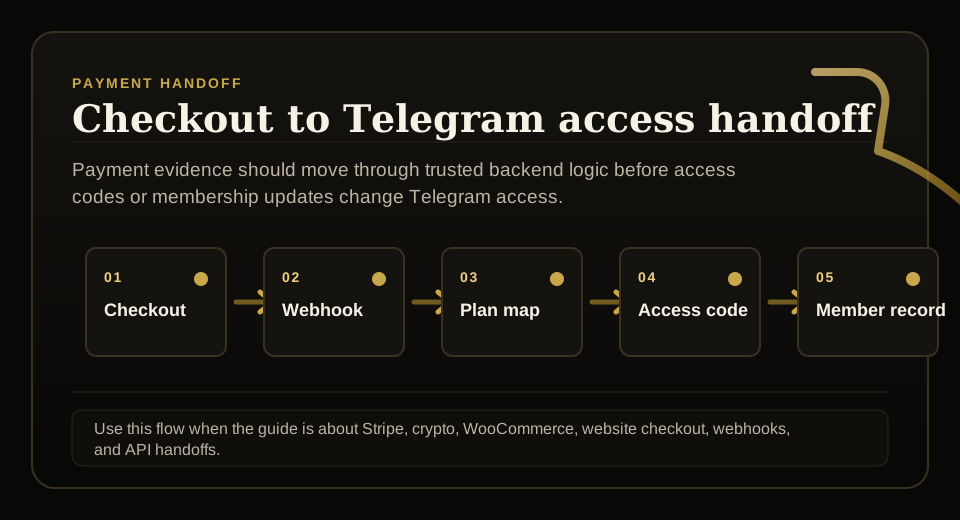
- Define the Ghost event that proves the buyer is entitled to Telegram access.
- Map that evidence to plan, duration, Telegram identity, destination, support owner, and expiry state.
- Use a controlled access-code, join request, or backend membership update instead of sending a permanent private link.
- Run the proof path: test new subscriber, cancellation, comped access, renewal failure, member lookup, and removal.
Treat Ghost as the checkout source
Ghost can confirm that a purchase, supporter tier, course enrollment, or membership event happened.
For paid Telegram access, that evidence still needs to become a member record with Telegram identity, plan, status, expiry, and support context.
Route access through a membership record
The access workflow should not be a reusable invite link pasted into a receipt email.
For this use case, newsletter membership state should decide whether a subscriber can join, renew, recover, or lose Telegram access.
Test the edge cases before traffic arrives
The common failure is running paid newsletter access and private Telegram access with separate cancellation and expiry rules.
The proof path should cover test new subscriber, cancellation, comped access, renewal failure, member lookup, and removal.
Keep integration claims honest
Google's current guidance favors helpful, reliable content over AI or SEO tricks. A page that explains the real handoff is stronger than a page that invents unsupported integrations.
The boundary for this page is simple: describe the membership-state handoff, not an undocumented direct Ghost integration.
FAQ
Can Ghost grant Telegram access automatically?
Only if a verified backend or automation path is actually implemented. Otherwise, use Ghost as the checkout evidence source and let the membership system decide Telegram access.
What should a Ghost to Telegram workflow prove?
It should prove payment or membership evidence, Telegram identity binding, controlled invite or access-code handoff, cancellation and refund handling, support lookup, expiry, and removal proof.