Quick takeaways
- Define the scaling surface: member records, bot permissions, plan mapping, admin seats, support queues, access-code limits, renewal reminders, reporting, and rollback.
- Keep control tied to evidence: a go/no-go checklist that ties each scaling risk to a tested owner, evidence source, and next review date.
- Name the scaling risk: scaling before support, data quality, and removal proof are ready creates operational debt that is hard to reverse.
- Require proof before scale: turn scale readiness into a checklist with evidence instead of relying on traffic or revenue goals.
Use Telegram group management scaling checklist to evaluate Telegram group management at scale: member records, admin roles, support lookup, access evidence, renewals, removals, and rollback paths.
Use this guide when the membership record, member status, plan, renewal, or support view has to settle the access decision.
Next read: Telegram Paid Group Launch Audit.
How this guide was produced
Every guide is written for the same paid-access workflow: payment evidence, Telegram identity, plan status, support lookup, and expiry enforcement.
Published by KickThemBot from product documentation, launch runbooks, integration tests, and paid-access operating procedures.
Membership lifecycle planning: plan setup, Telegram identity, subscriber status, renewals, support lookup, and expiry enforcement. Automation may assist drafting and page generation; indexed guides are selected for a distinct user job and reviewed against the documented workflow. Claims avoid fake rankings and hidden guarantees.
To help admins make a safer access decision before moving members, payments, invite paths, or expiry rules.
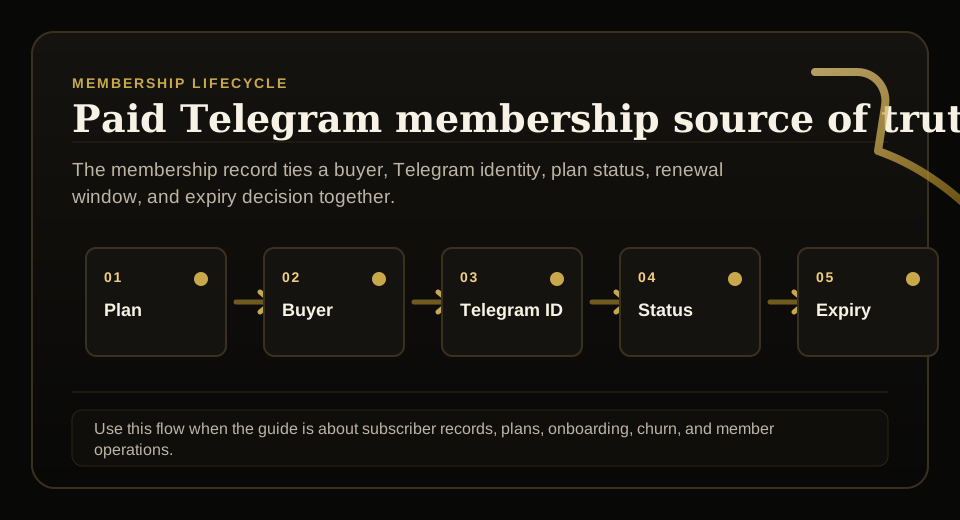
Implementation steps
- List the members, admins, destinations, and support paths included in scale: member records, bot permissions, plan mapping, admin seats, support queues, access-code limits, renewal reminders, reporting, and rollback.
- Decide which records control access: a go/no-go checklist that ties each scaling risk to a tested owner, evidence source, and next review date.
- Document what breaks first at scale: scaling before support, data quality, and removal proof are ready creates operational debt that is hard to reverse.
- Run the proof step before adding more traffic or members: turn scale readiness into a checklist with evidence instead of relying on traffic or revenue goals.
Define what is actually scaling
A large Telegram group is not only a bigger chat. It usually means more payment states, more support cases, more admins, more expired members, and more chances for access drift.
For this workflow, the scaling surface is member records, bot permissions, plan mapping, admin seats, support queues, access-code limits, renewal reminders, reporting, and rollback.
Keep the source of truth visible
The planning notes for KickThemBot emphasize Telegram ID, access codes, project sharing, and tested removals. Those controls matter more as the number of members grows.
The control model should include a go/no-go checklist that ties each scaling risk to a tested owner, evidence source, and next review date.
Expect small mistakes to compound
At low volume, an owner can often spot mistakes manually. At scale, the system needs filters, reports, audit trails, support summaries, and rollback decisions.
The risk is scaling before support, data quality, and removal proof are ready creates operational debt that is hard to reverse.
Prove readiness before adding traffic
Scaling should follow proof, not hope. Before more buyers enter, test the same workflows that create the most support load: access, renewal, cancellation, expiry, removal, and recovery.
The proof focus is to turn scale readiness into a checklist with evidence instead of relying on traffic or revenue goals.
FAQ
What is Telegram group management scaling checklist?
It is a checklist for deciding whether a Telegram group management setup is ready for more members, admins, payments, and support volume.
What breaks first when a paid Telegram group scales?
Usually member lookup, renewal tracking, support ownership, invite control, expired-member removal, and admin permissions break before the chat itself does.