Quick takeaways
- Do not transfer database ownership while projects still depend on bot tokens controlled by the lost account.
- Verify the replacement owner's numeric Telegram identity and each new bot through BotFather and getMe evidence.
- Inventory outstanding access codes, invite links, connected chats, API consumers, and payment custody before mutation.
- Apply ownership, bot identity, and credential rotation in one guarded maintenance transaction where possible.
- Keep writes frozen if the transaction commits but external verification is incomplete.
Recover from a lost Telegram bot-owner account by proving the new owner identity, creating replacement bots, inventorying access links and consumers, migrating memberships transactionally, and verifying rollback before retiring legacy credentials.
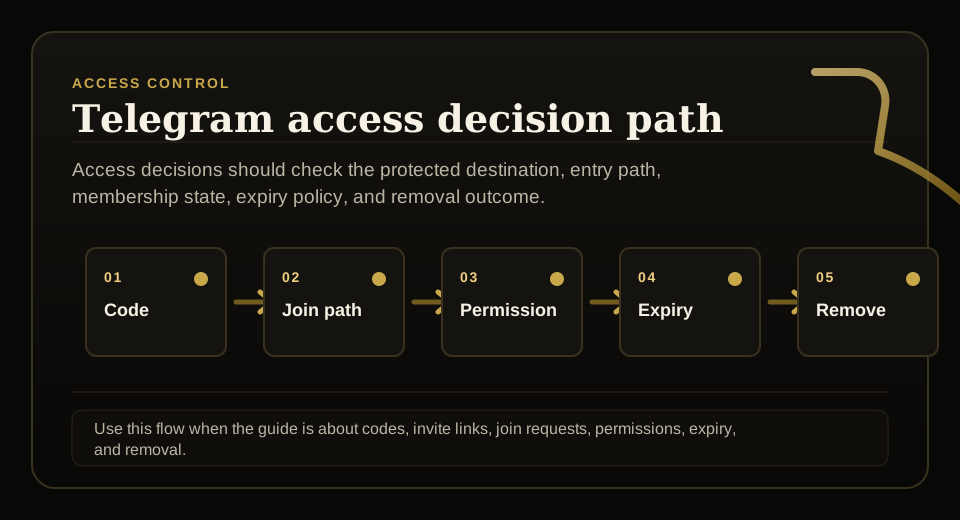
Use this guide when the main risk is unsafe entry, leaked access, expired members staying inside, or admins changing permissions manually.
Next read: Telegram Bot Ownership Transfer for Membership Bots.
How this guide was produced
Every guide is written for the same paid-access workflow: payment evidence, Telegram identity, plan status, support lookup, and expiry enforcement.
Published by KickThemBot from product documentation, launch runbooks, integration tests, and paid-access operating procedures.
Access-control planning: private destinations, access codes, join paths, bot permissions, expiry policy, and removal tests. Automation may assist drafting and page generation; indexed guides are selected for a distinct user job and reviewed against the documented workflow. Claims avoid fake rankings and hidden guarantees.
To help admins make a safer access decision before moving members, payments, invite paths, or expiry rules.
Ownership recovery controls for a replacement-bot migration
| Control | Required proof | Reason |
|---|---|---|
| New owner identity | Numeric Telegram user ID and authenticated application session | Display names and usernames can change |
| Bot custody | BotFather ownership plus token-to-username getMe match | A token map is not ownership proof |
| Chat authority | Invite and restrict rights for every protected destination | Replacement bots must enforce entry and removal |
| Project inventory | Exact project IDs, old owners, plans, memberships, and chats | Prevents partial or cross-project migration |
| Outstanding links | Credential-free inventory approved immediately before apply | Old codes may grant access after cutover |
| Payment custody | Expected Stripe account and explicit connected/disconnected state | Database flags do not prove settlement control |
| Database safety | Restorable backup and replica-set transaction support | Ownership spans several collections |
| Scoped helpers | Single-use invitation, explicit projects, expiry, and audit trail | The new owner remains the sole authority |
| Consumer rotation | Each website and service tested with its new project key | Old keys cannot be removed blindly |
| Committed recovery | Durable migration ID and verification-only resume path | A crash after commit must not trigger a second apply |
| Legacy retirement | Replacement lifecycle proof before revoking old credentials | Avoids trading an ownership incident for an outage |
Implementation steps
- Record the exact projects, legacy owners, service bots, chats, plans, access links, API consumers, and payment accounts in scope.
- Initialize the replacement owner in the application and verify the numeric Telegram user ID independently.
- Create one replacement service bot per project under the new BotFather owner and record getMe identity proof.
- Take a restorable database backup and prove transaction support before preparing any ownership write.
- Run a dry run that reports all affected records and every still-redeemable access path without exposing secrets.
- Obtain an authenticated, short-lived approval for that exact inventory and drain writes into maintenance mode.
- Apply ownership, replacement bot references, scoped team access, old-link retirement, and API-key rotation atomically.
- Verify Telegram permissions, project visibility, helper restrictions, payment custody, consumers, joins, renewals, expiry, and removal before unfreezing writes.
- Retire legacy credentials one at a time only after the replacement path is independently proven.
Separate display branding from operational ownership
Changing a visible project name does not move BotFather custody, rotate service-bot tokens, update Telegram chat rights, change payment settlement, or revoke old API consumers. Treat those as separate assets with separate evidence.
Define one canonical owner identity and keep helper access project-scoped. A helper may support selected memberships without gaining billing, credentials, project creation, or future-project authority.
Use replacement bots when the original owner cannot participate
If the old BotFather account is inaccessible, a normal bot transfer may be impossible. Create new bots under the recovered owner, verify their identity from the token, and add them to every destination with the exact rights the lifecycle needs.
Do not reuse a token merely because it still works. Continued runtime access does not prove the company controls the bot or can recover it after revocation.
Inventory access paths before replacing identities
Outstanding access codes and invite links can outlive the bot that issued them. Record which paths remain redeemable, which memberships depend on them, and which links must be retired during cutover.
The approval should bind to a hash or exact inventory and expire quickly. If records change, rerun the dry run rather than approving a stale snapshot.
Keep the database cutover atomic and recoverable
Ownership touches projects, plans, memberships, access codes, delegated roles, API credentials, bot references, and audit state. Apply them in one transaction with normal writes blocked so no checkout or redemption observes a half-migrated project.
If commit succeeds but verification is interrupted, persist a committed-pending-verification state. Resume verification by migration ID; never rerun the apply or patch individual records by hand.
Verify external systems before reopening traffic
Database consistency cannot prove BotFather custody, Telegram permissions, Stripe settlement, website configuration, or a consumer's deployed key. Check each external boundary directly after commit.
Use controlled join, renewal, cancellation, expiry, and removal tests. Verify the owner sees every intended project while a helper sees only the projects and actions granted by the invitation.
Retire legacy access only after replacement proof
Rotate project API keys, bot tokens, webhooks, website secrets, and operator access in a recorded sequence. Test each replacement before removing the old value so failures have a narrow cause and a safe rollback.
Finish with a zero-usage check for old credentials and an inventory showing who owns every production account. The migration is not complete while an inaccessible account remains a recovery dependency.
FAQ
Can a Telegram bot be moved if the original BotFather owner account is lost?
A normal transfer generally requires the current owner. When that owner cannot participate, the safer operational path is often to create replacement bots under the recovered owner and migrate projects, chats, links, and consumers under a controlled cutover.
Should memberships be recreated during a replacement-bot cutover?
Not blindly. Preserve valid membership and payment evidence, migrate references transactionally, and reconcile uncertain or duplicate identities instead of inventing new entitlements.
Can a support account help without becoming an owner?
Yes. Use a single-use, expiring invitation for explicit project IDs and permissions, with owner-only billing, credentials, project creation, and future-project controls.
When can old bot tokens and API keys be revoked?
After the replacement bots, chats, buyer lifecycle, websites, and API consumers have each passed an independent test and the rollback path is recorded.